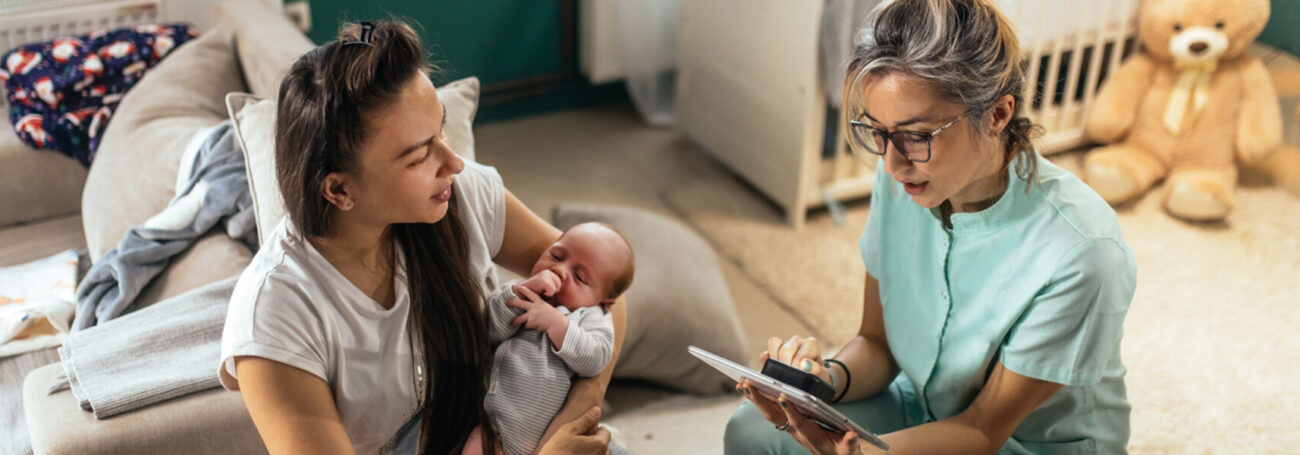
Home visiting is a service delivery strategy that connects expectant parents and caregivers of young children with a designated support person—typically a trained nurse, social worker, or early childhood specialist. Services are voluntary and provided in the family’s home or at a location of their choice.
A two-generation approach, home visiting delivers both caregiver- and child-oriented services to help the whole family. It views child and family development from a holistic perspective that encompasses—
- Child health and well-being
- Child development and school readiness
- Positive caregiver-child relationships
- Caregiver health and well-being
- Family education and employment goals
- Family functioning
States, territories, the District of Columbia, and Indigenous organizations implement home visiting models that match the needs of their communities using varied funding streams, including the Maternal, Infant, and Early Childhood Home Visiting (MIECHV) Program.
Home visiting has a strong evidence base, with many studies showing that it works. (Source: For a more comprehensive review of the evidence base for home visiting, see Components Associated With Home Visiting Program Outcomes: A Meta-Analysis retrieved from [https://www.ncbi.nlm.nih.gov/pubmed/24187111](https://www.ncbi.nlm.nih.gov/pubmed/24187111).)Go to footnote #>1 There are currently 18 evidence-based home visiting models operating in the United States that meet standards of evidence as determined by the Home Visiting Evidence of Effectiveness (HomVEE) project. (Source: The 2026 Home Visiting Yearbook defines evidence-based home visiting as models that have met standards of evidence as determined by HomVEE.)Go to footnote #>2
Innovative Partnerships to Build Healthy Families

Since 2021, Native American Professional Parent Resource (NAPPR) has offered weekly fresh produce to New Mexico families receiving
tribal home visiting services. Participants receive fresh, in-season produce provided by a local farm, the Indigenous Farm Hub, through its community-supported agriculture program. This collaboration—the idea of a parent and previous home visiting participant—highlights the ways home visiting programs are innovating to partner with local resources to meet the needs of the families in their communities.
“In the process of researching the Indigenous Farm Hub, I came across all of these incredible projects that are already in the works. You don’t have
to reinvent the wheel or start from scratch; you can collaborate in a way that is mutually beneficial with other programs that have like-minded goals for the families they’re working with. ” —Aliandra Maes, director of NAPPR’s Dental Support Center and Tribal Home Visiting Program