Home Visiting Then and Now
When the National Home Visiting Resource Center launched in 2017, no single source had documented the national home visiting data landscape. The 2017 Home Visiting Yearbook built a platform and infrastructure to compile available data about the families being served, the local agencies providing services, and information on the millions of families who could benefit. Since then, the NHVRC has continued to collect and expand the data available about the home visiting landscape. Join us for a reflection on what was happening then, where we are now, and where we can go.
Introduction to the Field’s Growth Reaching Families in Need
Over the past decade, home visiting programs have expanded their reach from operating in approximately 40 percent of U.S. counties to more than half of counties nationwide. Because local agencies serve families in nearby and sometimes distant communities (not just where they operate), home visiting services actually reached families in 85 percent of U.S. counties in 2025. This reach demonstrates the field’s ability to meet families where they are. Still, an estimated 16 to 18 million families could benefit from home visiting services each year, underscoring continued opportunities to strengthen access nationwide.
 The period of growth between 2015 and 2024 has been shaped by sustained investment in and adaptation of home visiting across states and communities. Continued federal support, demonstrated through repeated reauthorizations of the Maternal, Infant, and Early Childhood Home Visiting (MIECHV) Program, has helped underpin the field’s infrastructure by funding workforce development, evidence building, and data-driven continuous quality improvement and providing technical assistance to states so that programs can focus time and funds on serving families. Increased funding for tribal home visiting has strengthened culturally grounded services in Indigenous communities and supported expansion in historically underserved regions. Programs have also evolved in response to changing family needs and broader structural barriers. The rapid shift to virtual home visiting during the COVID-19 pandemic demonstrated programs’ capacity to adapt and reinforced a deeper focus on whole family approaches.
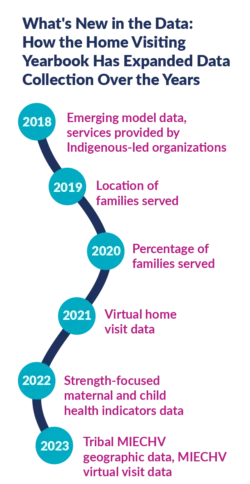
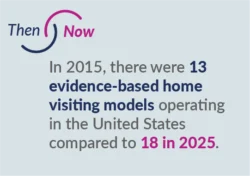
The National Home Visiting Resource Center (NHVRC) has tracked the field’s evolution by compiling national data, documenting changes in models operating in the United States, and reporting consistent cross-model and funding stream data over time. When the NHVRC released the first Home Visiting Yearbook in 2017, it included 2015 data from 12 models. Today, 25 evidence-based and emerging models contribute information about families served by home visiting and the staff who deliver those services. Along with including more models, the NHVRC has added new measures and expanded data collected to capture geographic reach, families served, maternal and child health indicators, Indigenous-led home visiting, and COVID-19 pandemic-related shifts.
 The timeline above highlights the steady expansion of Home Visiting Yearbook data collected over time to reflect shifts in the field and to offer a fuller picture of the growing national home visiting landscape.
 With 10 years of coordinated national data now available, we can step back and examine longer-term patterns about where and how home visiting has expanded. As the field’s capacity to collect and share data has grown, so, too, has the evidence base, giving us a richer foundation to highlight areas of need and deepen our understanding of home visiting trends.
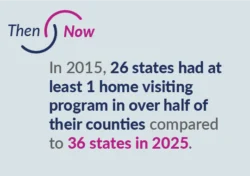
 Geographic reach has expanded in meaningful ways across states and counties, for example, with 36 states now offering at least 1 program in more than half of their counties.
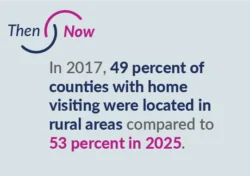
At the same time, important gaps in service area remain. While 53 percent of counties with home visiting are rural, counties without home visiting are even more likely to be rural (79 percent).
In the months ahead, the NHVRC will release a series of blog posts drawing on a decade of national data. These snapshots will take a closer look at—
- How 10 years of national data help us understand the field’s expansion and its evolving practices
- How the geographic reach of home visiting has changed over time
- How expansion aligns with indicators of family need, where gaps in access remain, and where future growth could have the greatest impact
Together, these products will provide a clear, data-driven view of home visiting’s progress reaching families with young children; they will also highlight where the field can focus future efforts to improve access for all children and families.
The NHVRC is a partnership of James Bell Associates and the Urban Institute. Support is provided b the Heising-Simons Foundation. The views expressed here do not necessarily reflect the views of the foundation.
Suggested citation: Atukpawu-Tipton, G., & Meisch, A. D. (2026). Home visiting then and now: An introduction to home visiting’s growth reaching families in need. National Home Visiting Resource Center. James Bell Associates. https://nhvrc.org/home-visiting-then-and-now/
Acknowledgments: A number of people contributed their time and expertise to supporting the analyses and creation of the Then and Now series. We acknowledge the contributions of other members of the NHVRC team, including Heather Sandstrom, Jill Filene, Elly Miles, Erin Doyle, Alexandra Joraanstad, Alavi Rashid, Joelle Ruben, Mikaila Singleton, and Kris Neurauter.